Saturday, September 20, 2014

Wednesday, September 17, 2014
Spending a week at St. Louis with Glenn and Kim, we had copious categories of activities to choose from, much of it free to the public. In fact, it would take months to just visit them all. We took the informative, educational, and entertaining docent-guided Trolley Tour, for an extensive overview of the city attractions, followed by lunch in the Laclede’s Landing neighborhood.
Of course, we began our exploration with the world-famous, stainless steel Gateway Arch/Museum of Westward Expansion and Busch Stadium, home of the 11-time world champion, St. Louis Cardinals.
We explored Forest Park, with all it cultural venues, and the Zoo. Afterwards, we treated ourselves to the scrumptious, Ted Drewe’s ice cream and in a gluttony fashion, sampled gooey butter cake. To confess our sins, we attended Mass at the Old Cathedral(1834). For penance, we toured the Anheiser-Busch brewery, to visit the Clydesdales, and see how Budweiser is made.
Another outing included a visit to the Science Museum, followed by lunch at “Sweetie Pies”. In the afternoon, we toured the Old Courthouse and Museum, offering a fascinating glimpse into the early judicial system “West of the Mississippi“.

Today, we visited the old Union Station, now renovated into an upscale shopping, entertainment, and dining venue. The Grand Hall and Hotel, based on the Romanesque style, are a showplace, reflecting the grandeur and opulent interior spaces of the National Historic Register Landmark.
Next, we visited the New Cathedral Basilica(1907). The extensive mosaics, largest collection of mosaics under one roof in the world,  depict the life of patron, Saint Louis IX, King of France, and the story of the Catholic Faith, from creation to the last judgment. This Cathedral is as impressive as any that I ever saw in  Europe (excepting Saint Peters in Rome).
We munched a fine picnic lunch at Forest Park and then headed to the “Delmar Loop”, a very engaging west-St. Louis neighborhood, around Washington University. The “St. Louis Walk-of-Fame” along both sides, honors the famous folks of the city.

 During our St. Louis week with Glenn and Kim, we drove ourselves about each day, perusing the neighborhoods and various sections of the city. From our RV site on the Illinois side, in Cahokia , we ultimately crossed each of the magnificent bridges, old to new. St. Louis has fascinating architecture, historic attractions, vibrant landscaping, ethnic neighborhoods, multi-cultural dining, exhausting shopping, and lots of entertainment opportunity. It would be necessary to dwell a year in residence to experience it all. Maybe we’ll do that sometime!
9-20 Today, we head over to Madison, Indiana for a visit and Amy’s Birthday.
 Bob and Glen wanting to get in to the ball park!
 Historic Court House museum in St Louis
 View from the Ball Park and below slightly younger than the oldest Catholic Church in St Louis is this beautiful church

Sunday, September 14, 2014

Now here’s a tidbit of information that I have discovered in the Minnesota prairie;
Lots of American farmers are growing corn, fencerow-to-fencerow, to supply ethanol plants. The ethanol plants have built up in the large farm areas, economically, to be close to the corn production. The finished ethanol product is then shipped by rail tank-car to where it is  blended with petroleum gasoline.

The average per acre production of corn will yield approximately 330-424 gallons of ethanol per acre. A 15% blend of ethanol in one gallon of gasoline will reduce greenhouse-gas emission by 10-20%. This year, about 90% of the US gasoline sold, contained 10% ethanol. The EPA has now approved 15% ethanol in vehicles later than 2001 models. Also, I am seeing gasoline blends with 85% ethanol at the pumps, advertised to be burned in flex-fuel vehicles. Don’t put this in your Ford truck!
Biotechnology is working to increase the ethanol yield from corn and other crops like sugar cane, sorghum, grasses, and even wood chips could become candidates for ethanol production. Currently, only the corn grain or kernel is used in the ethanol production process which involves fermentation, distillation, and dehydration. It is possible to use the entire corn plant in ethanol production and that may be a future development.

As expected, negative effects have arisen as challenges to ethanol manufacturers. For example, advances are being made to reduce the fuel-system corrosion effects of ethanol fuel. Also, the manufacturing process of ethanol produces hazardous gases called volatile organic compounds (VOCs) along with other air, water, and ground pollution compounds, as an undesirable by-product.

Ethanol is the same ethyl alcohol that we have in beer, wine and hard liquor but with a laundry-list of potentially dangerous additives. The EPA and other government agencies monitor this product but they rely primarily on data principally from the manufacturers and that has already become an issue. Hopefully, the issues will be resolved in a responsible manner to avoid any SURPRISE future environmental and/or health disasters.
In the meantime, just “fill er up”!


Tuesday, September 2, 2014
While exploring the Granite Falls area, we met a lady who taught school in the one-room schoolhouse, which is now a part of the Granite Falls museum complex. Her farmer husband passed away at age 90 and she moved to town, turning the farm over to someone else. As she answered our questions, it was like going back in time, to a much different period of SW Minnesota life. We had a good visit and she was a real inspiration to us.
After a relaxing, five-day, Labor Day visit at the Prairie’s Edge Casino and Granite Falls area, we continued our travels toward St. Louis. The Casino was truly on the prairie edge, as the glacial Minnesota River Valley is a wooded green-belt oasis, cut to the bedrock,  right through the wide-open prairie. The glacial floods forming the Minnesota River Valley,  some 14-thousand years ago, exposed some of the oldest rock in the world.
As we drove down the river, in the cool, clear morning air, we saw large flocks of White Pelicans spiraling on the morning thermals, along the river valley. We also passed large agricultural crops with thousands of acres in corn, soybeans, and sugar beets.

Redwood Falls, MN is an 1864 town that was taken form the Dakota Sioux after the Dakota War of 1862. The US treaty of 1851 moved the Sioux to a concentrated tract along the Minnesota River, in exchange for payments and provisions by the US government, that was botched. The starving Sioux went on the “warpath”  and in the end 38 Sioux were hanged. You can still see memorial “spirit catchers” placed by the current Sioux community. Ironically, the Upper Sioux community now resides along the river, on a portion of the original tract. It’s common to see the senior Sioux people in WalMart and shopping around town but ot seems that the young Sioux leave the community.

We have met and talked with numerous Minnesota RV’ers who go south for the winter. Many are out on shakedown cruises getting ready to head south in October/November. They return in March/April. South Texas and Arizona are their popular destinations for the winter. I think the south Texas (Rio Grande Valley) would be a fun winter location, as it is on a latitude with Miami. Looks like we have winter quarters set for Las Vegas at the Clark County Shooting Complex.

Jeffers Petroglyphs are located in southwest Minnesota on a flat quartzite outcropping laid bare and smoothed out by glaciers 14 thousand years ago. The ancient images were pecked into the flat, quartz slab by the native inhabitants some 7-9 thousand years ago.
The present Sioux people consider this to be a sacred place where “Grandmother earth speaks of the past, present and future“.  I guess you have to read the book on that one!

Spirit Lake, in northwest Iowa, is part of a group of ancient glacial lakes that are deep, clear, and blue. Called the “Great Lakes of Iowa“, the area has become a popular resort area. Lots of campgrounds and recreational opportunities. We camped on the Lakeshore at a nice RV park at Spirit Lake. The area is highly developed as a resort locale serving Iowa and the surrounding states. The owner loaned us his grease-gun so that I could lube my truck front-end. Nice folks!

We camped next at Audubon, Iowa in the middle of Iowa farm country. We shared the campground with two Iowa farm families who were just relaxing before the corn and bean harvest begins. After harvest, they’ll take their RV trailers and spend the winter in the Rio Grande Valley, in south Texas.
Audubon is named for John James Audubon who frequented the Mississippi River drainage searching for birds. We did see some birds. Audubon town has a thirty-foot tall Herford steer as a monument to their cattle and beef industry. Additionally, the region produces pork.
The cattle are fed on feedlots and the pigs are grown in long, metal barns. Driving on US 71, we played “name that barnyard smell“, as we passed the numerous farms! The cramped feeder operations appear and smell unhealthy but that’s the way they do it. They just pump in the feed, minerals and antibiotics. Feeding farm animals and ethanol production has increased the Iowa corn crop to a record, 14.6 million acres, according to Iowa State University statistics.

On Thursday, the weather was hot, windy,  and humid. We were missing the cool Minnesota days but that’s not slowing our plans to meet Kim and Glen for a visit in St. Louis. Today, it has cooled down for our first morning in St. Joseph, on the Missouri River,  where “the Pony Express began and Jesse James ended”.
We have visited beginning and the end of the old Pony Express route, St. Joseph in the east and Sacramento in the west. I guess you could call the riders “the first postal workers”!
We spent the day exploring old town St. Joseph and shopping the new town. Lots of impressive architecture, historical sites, and splendid sights are abundant in the old town, along the Missouri River. It was cloudy and cool making a good day!

Saturday, September 6, 2014
Today we traveled east on US36 from St. Joseph to Hannibal, Missouri. Crossing the north of the state, we encountered lots of corn and bean crops and saw the farmers beginning to combine the harvest. Fall was in the air today and listening to the Missouri football game made it even more fall-like. Also, we saw lots of fall wildflowers like; Sunflowers, Blackeyed Susan’s, Blazing Star, Bee Balm, and lots of colorful grasses. We stopped at Chillicothe for lunch and WalMart shopping and talked to some Rvers heading to northwest Wyoming. It made me reflect on the terrific fall scenes in the Rockies, with the Aspens and Cottonwoods in full fall color, an awesome spectacle!

Today, we attended mass at Holy Family Catholic Church and spent remainder of the day exploring Hannibal. Lovers Leap is a high limestone precipice overlooking the Mississippi River and Hannibal, from the downstream side of town. It was a quite, tranquil, observation place, with a light, cool, north  breeze and you could imagine what Samuel Clemens’s Hannibal was like. You could write your own story here, and I met one young lady, a student at Hannibal LaGrange University, who was doing just that. Maybe she will be the next Mark Twain!

Along the river, we toured the park and public docks, a nice facility for river watchers and recreational boaters. The nostalgic Mark Twain riverboat was waiting to cruise the river, providing commentary on the history and sights.
We walked on Main Street and perused the tourist shops and stops, ending with a climb up to the Mark Twain Memorial Lighthouse for a north side view of town and the river.
Along Main Street, we encountered Tom and Becky, in full dress, in front of the Mark Twain boyhood home. Their parents were close by and we learned how two seventh-graders (boy and girl) are chosen each school year to play the role, as eight-graders. A serious annual competition and quite an honor for the winning couple, to play the famous literary couple.

We walked out to the end of the old Mark Twain bridge approach, now a small city park, for another overlook of the Mississippi River. The old bridge was demolished when the new Mark Train bridge was opened.
Yes, Hannibal is everything Mark Twain and they depend heavily on tourism to keep it going. Like many small towns, the local industry has dwindled and left lots of empty, derelict buildings and an eroded tax base.  

Heading on down toward St. Louis, we decided to travel the west bank and then cross over to Illinois at the next bridge. Meandering down the Mississippi River, along the steep, curvy, Missouri “Great  River Road” (MO79) we enjoyed some scenic overlooks from the limestone bluffs. The Missouri bank has high bluffs, while the Illinois side is a flat prairie. We saw fall influences in the tree colors along the river. We also observed several small plots of a short shrub, deep maroon foliage, in rows,  like plant in rows.
Blueberry?????
At Louisiana, Missouri, we crossed the river to the Illinois bank and continued south on the flat agricultural prairie, (IL96) to Pere Marquette State Park. The corn harvest has begun here and the combines, grain carts, trucks, and elevators are frenzied. We met two retired farmers relaxing at the State Park and I asked; “you guys don’t seem too concerned about the corn harvest”? They amusingly replied “no, we turned the farm over to someone else” The small family farms of the past are now large agribusinesses with immense plantations. They own large tracts and they also rent aas much land as they can manage. Many of the old farmers are getting rent and lease checks on the land they own and previously farmed. I talked one farmer that sold out for 5-thousand per acre.

Pere Marquette State Park, a 1930’s CCC Project, is situated close to the confluence of the Illinois River with the Mississippi River, about thirty miles upstream from St. Louis. We studied French explorers Marquette and Joliet in American History but had never seen any monuments to their 1673 expedition. As they traveled from the Great Lakes down the inland rivers, Father Marquette was very impressed with the area around the Illinois and Mississippi River confluence. We visited his memorial cross, located near the confluence. The one-piece, stone cross was hewn from a slab of native limestone and overlooks the 1763 confluence. The confluence has since shifted a mile south, where Grafton is now situated. This area is also the prime wintering grounds for the american Bald Eagle.
We met a retired river pilot at the fish house in Grafton and he related his interesting experiences from his life on the rivers. While there, we observed two recreational cruisers heading downriver. Flying the American Great Loop Cruisers Association burgee, they are on the inland river leg of the “Great Loop”, right on schedule to make south Florida by December. We were envious but glad we’re not out there now. The lead boat was probably in the neighborhood of a three-quarter million price tag. They can afford to cruise the “Great Loop” with a leisurely style, in great comfort.

Camp River Dubois, the point of departure for the Lewis and Clark Corps of Discovery into the Louisiana Purchase, an uncharted wilderness, was the Lewis and Clark (1803-1804) winter camp. When Camp River Dubois was the edge of the United States, the expedition set out to explore the lands west of the Mississippi. Situated at the confluence of the Missouri and Mississippi Rivers, they planned, trained and made final preparations for the long journey to the Pacific Ocean. The docent was an authority on the expedition and an excellent interpreter. We have now visited the three winter camps, the beginning middle, and the end, at the Mississippi, Mandan Village,  and the Pacific, including most of their in-between historic sites. Now it’s easy to understand and appreciate the momentous journey and comprehend their great contribution to America.

We visited the U.S. Army Corps of Engineers, St. Louis District, Visitor Center at Lock and Dam number 15.They have educational models of the Mississippi River system, lock and dam tours, and an excellent museum on river commerce and life. Here you will gain an appreciation for the services of the Corps in maintaining the river channel, pool levels, and navigation aids. They have a superb staff to answer questions and assist visitors. America has a great story and a river is on every page of it.
Having observed vast corn crops along the river, we learned that; not all the corn is transported on the river, but an estimated 19 million tons of corn will come down the Mississippi River this year.

We have immensely enjoyed our stay at Pere Marquette, the oldest State Park in Illinois, this week. Exploring the park and the surrounding area between the Illinois and Mississippi rivers has been enlightening, tranquil, and entertaining. It truly is a unique area and we can now see why Father Marquette was so overwhelmed by the area.
We liked it too!

Friday, August 29, 2014

Thursday, August 28, 2014
Today, we departed Bemidji and headed south on US Highway 71 to Granite Falls. We had a leisurely drive through the Minnesota “North Woods” past Wildflowers, Aspens, Pines, Larch, Birch, abundant hardwoods, and numerous glacial lakes, then through the Long Prairie area, past large agricultural fields. We saw several more pairs of Trumpeter Swans in the north woods, along with many small lakes and marshes, with wading birds. Long Prairie was the site of the 1845 Sioux/Ojibwe/Wennebago Indian Agency. Unfortunately, these peoples were fierce rivals and somebody had to go. This opened vast lands to be grabbed by white settlers, so now we have lots of Scandinavian descendents here. We had a picnic lunch at Menahga, (means “blueberry bush” in Chippewa). At Wadena, the town has over 100 murals depicting “1000 years of Minnesota History”. Quite a puzzle!
In the prairie, we saw lots of corn, oats, wheat, barley, soybeans, alfalfa,  and sugar beets. Also, dairy farms are quit prevalent, along with game farms that provide for bird and deer hunting. We also took a short-cut and drove through an Amish Farm Community, an interesting contrast to their large-farm neighbors. The agribusiness farms in this area average several thousand acres. Fall is definitely approaching, as the leaves are beginning to show their fall colors.
In our Minnesota travels, we encountered the three-way continental divide (Laurentian Divide) of the north. We have encountered it previous travels here but never completely understood it’s significance. The roadside marker reads as follows:

A drop of rain water falling here in the Giants Range, a rare three-way continental divide, may flow either north into the icy Hudson Bay, east into the Atlantic Ocean, or south into the warm waters of the Gulf of Mexico.

From the north slope of these very old granite ridges, streams flow into the Red River of the North, through Lake Winnipeg, and into Hudson Bay in northern Canada.

Creeks and rivers on the south slope flow into the St. Louis River, enter Lake Superior at Duluth, and eventually reach the north Atlantic through the Great Lakes and the St. Lawrence River.

On a western spur of Giants Range the great watershed of the immense Mississippi River system gathers the flow from a maze of streams and swamps as the legendary river begins its winding course from Lake Itasca to the Gulf of Mexico, more than 2,500 miles away.

Lying as it does near the center of the North American continent, Minnesota marks the transition between eastern woodlands and western prairies and between northern coniferous forests and rich grain-growing land of the mid-nation.  It is a land of dramatic differences, tied to the world through three great waterways that originate in these rocks and streams.

We’re spending four days, over Labor Day weekend, at the Prairie’s Edge Casio and Resort, owned by the Upper Sioux Tribe, in Granite Falls, Minnesota. The area has lots of attractions and the Casino maintains a nice RV park and offers entertainment, and some scrumptious dining opportunities.
Granite Falls is situated on the Minnesota River, with an extensive outcropping of volcanic granite along it’s banks, and it can be seen all over the area. It’s the county seat of Yellow Medicine County, named for the yellow root of a medicinal plant used by the Native American Dakota people. The Minnesota River takes it’s rise just south of the Laurentian Divide (North Divide) and flows through here, on down to it’s confluence with the Mississippi River.
Wishing you all a relaxing Labor Day!
Bob (AND Terry)

Wednesday, August 27, 2014

Boy did I get behind on my notes. Terry has been much better than me. I make notes mainly for purposes of later reference AND to share with friends and family. Now, I have to go back and include some things that I want to incorporate and remember. This practice is inconsistent with the Blog format but it’s sometimes difficult to keep up chronologically. So, now it’s catch-up time:
Tuesday, July 1, 2014
Well the “Mighty Mississippi” is still on the rise. We have been aboard three nights and been through four severe thunder storms. The Savanna Marina is located on the east bank of the Mississippi River, at Savanna Illinois, in an old oxbow lake. With the river at flood stage, the water is pouring through the marina at 3-4 knots, with the water still rising. After a thunderstorm dumped three inches of rain on Sunday night, we awoke, Monday morning to find our 16-foot tender boat swamped and then capsized(Sunk). (An automatic bilge pump would possibly have prevented the mishap.) Thanks to a small group of our marina staff and neighbors, we successfully hauled it out.
The camaraderie and amusing stories made the unnerving task almost enjoyable. With the help of my new buddy, Frank (the marina manager), we got it dried out, cleaned, refueled, and running, just as another severe thunderstorm hit us.
We closely monitor the weather, so we knew the severe thunderstorm was coming from the west, but we were intent on finishing the boat repair. Just as we got it re-assembled and running, the storm hit, and thanks to our friends, we got everything stowed and secured just minutes before the severe weather part. (Keep in mind that we are living on the houseboat at this time.  Riding out the storms.)
Given the circumstances, we had to leave the boat resting on large timbers, on the edge of the parking lot, where we had hauled it out for the repairs. Aware that the river is still rising, we moored the boat over-night to my truck hitch, parked 60 feet up-hill, on  the parking lot. Well, we all had a chuckle this morning because the water was within 15 feet of my truck and my boat was bobbing around the parking lot, tethered to my truck. Frank was born and raised on the river, so he knew exactly what he was doing when he directed the project. So, the river floated our boat that yesterday, had been hauled out to dry land, and set on blocks for rejuvenating repairs. After moving the boat back to the dock, we returned to our daily activities.
Today, a steady stream of river-watchers have paraded around the partially flooded parking lot with dashed hopes for boating on the 4th of July weekend. The Army Corps and the DWF have closed the river to commercial and recreational traffic. The marina is closed to launching, so it will remain a quiet spot for boat owners and marina staff. I’ve heard lots of boaters complaining about a recurring, seasonal dilemma of not getting good river conditions until mid-July. We do not mind the wait. We are on river-time!
Just like we expected, every day brings a new challenge(s), and every day you learn the ways of the river. Out here, there’s a lot of wise counsel available and you had better seek it AND listen. We plan to stay safe, prepare and follow the guidelines.
7-17
After living aboard, moored at the pier, in the marina, we have arrived at the point that we can not get insurance without an expensive survey. Based on thorough investigation, we have elected to sell the boat and go back to a travel trailer. We are disappointed that we can not, in our current situation, continue with our live-aboard cruise plans. However, we know that this is the right decision for us. It’s just too physically demanding and would be too expensive and uncomfortable. See you on the road!
Tuesday, July 29, 2014
Last night, our fourteen-year-old Jack suffered a seizure, and it was heartbreaking to watch. He was  rigid, with moaning, and wailing for a few minutes. I thought that he was going to die but as he was struggling to get up, I helped to lift and support him and that seemed to slightly quiet and comfort him. For two hours following the seizure, he seemed totally disoriented and was desperately trying to find himself and make some degree of recovery. He finally drank water and went to sleep, and I just knew he wouldn’t wake up. We spent a sleepless night watching over him and this morning, he slowly got back to his normal state.
We did some research and discovered that there are two kinds of seizures most common in old dogs. Unfortunately, depending on the cause, it could recur. We will get him to a vet asap if it happens again.

Leaving Savanna, Illinois, we traveled up the upper Mississippi River, camping at the US Army Corp of Engineers Parks, situated on the various pools, behind each lock and dam structure. Grant River and Blackhawk were in remote settings but Goose Island is just south of La Crosse. Saw Sand Hill cranes here. We enjoyed visiting La Crosse, touring the Lady of Guadalupe Shrine, downtown river park and garden, and the UW-La Crosse campus. 

Leaving La Crosse, we traveled across Wisconsin, heading to Duluth, Minnesota. We followed the Mississippi River and the St. Croix River up to Superior and Duluth. We enjoyed sampling the cheese of Wisconsin but they are so abundant that it’s impossible to sample them all. Crossing the Wisconsin Ice Age moraines, we were surprised to see numerous sand mines, amid controversial political protests. We discovered that the sand had come into high demand by the petroleum industry and is used in the process of hydraulic fracturing to produce oil and gas from shale formations. The sand had special qualities that make it very desirable, so it is mined, sifted, sorted, and shipped, to meet the needs of the customer. Concurrently, local conservationists are trying to halt state sand-mining permits in order to protect the natural moraine.
At Eau Claire, Wisconsin, we discovered that this is the venue for the U.S. Championship in Kubb. It’s a Scandinavian game, popular in the state.

We spent a week at Duluth, visiting the Canal Park, Enger Tower, Aquarium, Spirit Mountain, ship docks, and the downtown. Duluth is situated on the north shore of Lake Superior, with steep hills directly adjacent to the town. It‘s called the San Francisco of the Midwest. First Street runs about one mile, from the water straight up the hill.
Duluth, Minnesota and Superior, Wisconsin are both large commercial shipping ports, adjacent to each other, situated on the west side of Lake Superior. This is one of the most impressive examples of teamwork, just the epitome of cooperation and coordination.  They move one-thousand-foot ships in and out of the harbor, facilitating the loading and unloading of all sorts of cargo. Specialized teams of pilots move the ships to and from the harbor incorporating/coordinating teams of tug boats and line handlers. Other teams conduct the loading process, while even more teams of folks manage the paperwork and technical aspects of insuring seaworthiness. For example, a gigantic, pelletized taconite, iron ore facility, receives the pellets from the Minnesota Iron Range, by rail. The rails cars are dumped into the ore dock facility, by the carloads . Next, the ore is conveyed into the ship hold by computer-controlled material handling equipment. The heavy ore has to be loaded in a certain sequence to avoid damaging or unbalancing the ship. One can observe the same activities at nearby elevators, in handling oats, wheat, cement, coal, and limestone.
Next, we traveled along the Lake Superior north shore to Two Harbors. Spending a few days at Two Harbors, we walked the lakeshore trail, saw the iron ore facility and shopped around the town. We took a day-trip to Gooseberry Falls State Park, a beautiful park with awesome waterfalls, at the lakeside.

Next, we drove north to International Falls and Voyageurs National Park, for a few days on the Boundary Waters. This place is a “river of lakes” dotted with numerous, rocky islands, varying from tiny to large.
We took a cruise on the Rainy Lake area and visited some old gold mines, saw Bald Eagles, Loons, and lots of islands. The International Falls Bass Championship was held during our stay and we got to see our first boat parade ever. With around eighty entries in the tournament, the opening event was a boat parade of the contestant teams. Each contestant team, friends, and family, parade along main street down to the tournament headquarters at the city park. Here they are introduced, as the truck/tailored boats pass the review stand. What’s strange is that it is a quiet parade; no bands etc. It’s like Mardi Gras but boats instead of floats. We also saw our first lawn-tractor drag races, as part of the tournament festivities. Each night, they had music and other entertainment for the visitors. Yes, Minnesota has lots of rednecks too! Ain’t life great!

Our next travel was down to Bemidji, Minnesota, where the mighty Mississippi River takes it’s rise. Saw Trumpeter Swans along this route. This area is home to several Indian reservations with casinos. It’s a WalMart town so it has all the accommodations that we need. We attended church at St. Phillips, a very impressive church and community. We have attended church almost every Sunday and large to small, we have been fulfilled.
Today, we explored  Lake Itasca State Park(1891), Minnesota’s oldest park, and headwaters of the Mississippi River. Itasca is a “lake of lakes” in an Ice Age glacial plain, consisting of 100+ interconnected lakes. The Mississippi River begins here and ironically, flows north to Bimidji Lake and then begins it’s 2600-mile course south to the Gulf of Mexico. At the headwaters, Terry waded across the river and I walked a log across. There were several places in the woods where you could literally step across the river. We had heard a lot of stories about this place but it was exhilarating to be here and witness it.
The day was cool and clear, with a light northwesterly wind. We saw a pair of Bald Eagles that were the largest we have ever seen. At the Visitor Center, we confirmed our sighting of a pair of Trumpeter Swans that we saw a few miles north of the park.
It was a good day!
Today is a mail day, meaning that our mail from the Green Cove Springs, Mail Forwarding Service will arrive at the Bemidji UPS store. We can use UPS or Post Office General Delivery to get our mail whenever we want it. Also, we can see it on the computer, whenever we want. We only forward a small portion of our mail for tangible things that we need in-hand like the dogs’ heartworm pills and the license plates for our new trailer.
Wednesday, August 27, 2014
As of today, we have made application for “winter-quarters” camp host jobs at three locations:
First- Las Vegas
Second- Southern New Mexico
Third- Southern California
We’ll keep you posted on the outcome. Maybe you can come visit!
Bob


Tuesday, August 19, 2014

Now we are in Minnesota and it is beautiful here too.

 Duluth, William A Irvin Ore Ship Museum
 Great Lakes Aquarium, Duluth.  A very beautiful Sea Horse, pregnant maybe?
 Enger Tower over looks Duluth MN harbor and city.
That long, green land mass is called Park Point.  We walked the beach there.
Looking out on Lake Superior as the Gooseberry River runs in to it.

 Here is the lower Goosberry Falls.  Bob is on the far left with Jack.
 Jack enjoying the lower falls.
 There are several buildings at this state park that were built by the CCC.  This statue is to commemorate their work.
 Upper Gooseberry Falls.
 I looked for sea glass all along the Atlantic coast from Florida to Maine.
 I found sea glass on a beach on Lake Superior.

Monday, August 11, 2014

Here are some more photos from our stay in Wisconsin:

 This "fossil" catfish was at the entrance of our campsite at a Corps of Engineers campground right on the MS river.
 Here is Bob relaxing on the front porch.
I love Urban Art.  These herons are the choice for urban art in La Crosse, WI. 
 We visited an international friendship garden in La Crosse.
 Another heron at the garden.
 We went to Mass at the Our Lady of Guadalupe Shrine here.  The gardens and buildings are breathtaking.
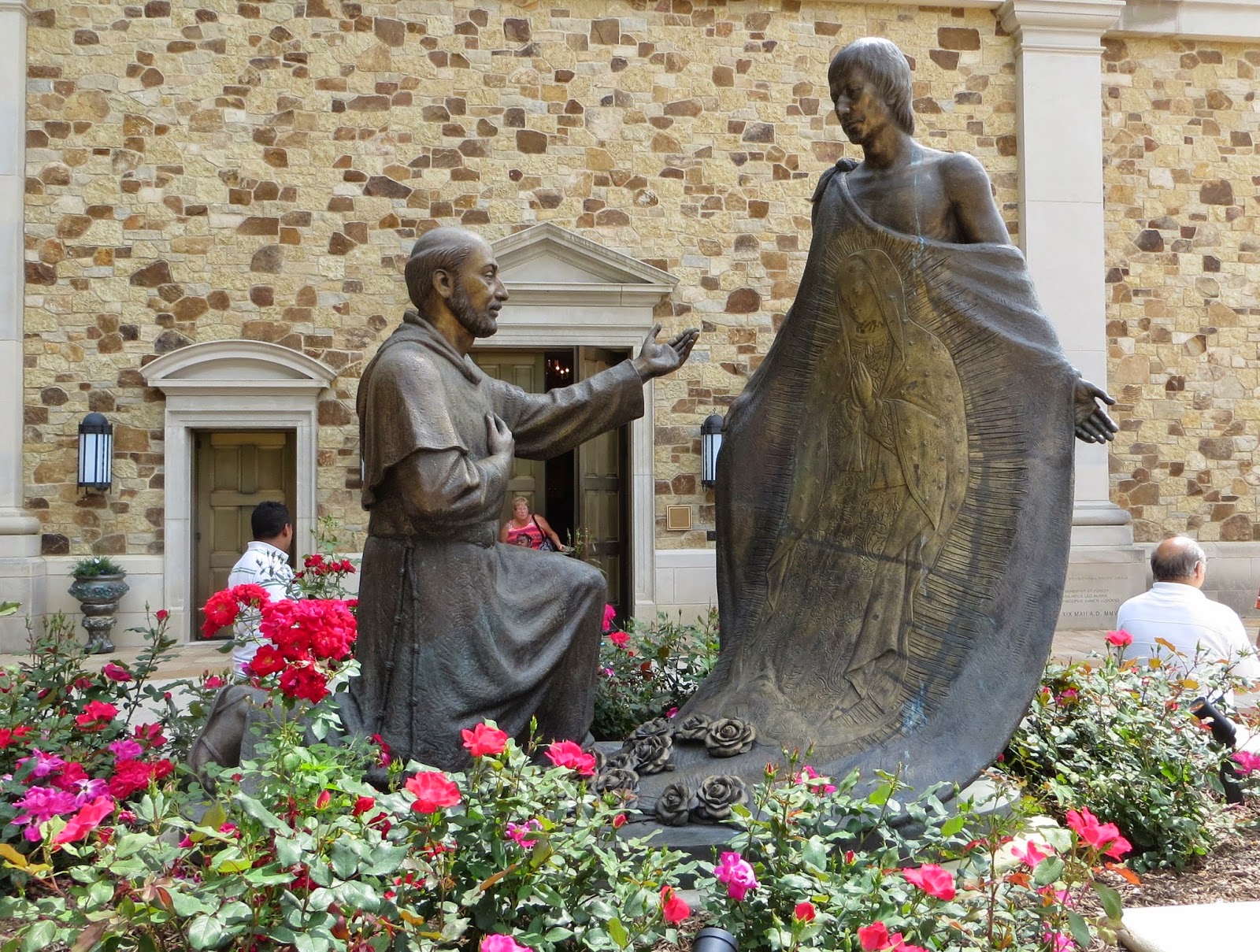
 Statue of Juan Diego showing the bishop proof of Mary on his cloak.
 The first native American saint Kateri Tekawitha.
The votive chapel.  It is incredible inside.  There are so many candles it is quite warm in there.

Sunday, August 10, 2014

We have not posted here in a while so here are some photos.  Bob will post some narrative soon.  We've been busy with the business of selling our boats and buying our new camper (land yacht?).  It has taken quite a bit to switch gears.  We are about to launch ourselves again though.

 Mt Carrol, IL, an old college we visited.  Beautiful grounds and buildings.
 The old college.
First night in our new camper at a very nice county park in Dubuque, IA.  They gave us a bottle of champagne to toast it with.  I thought about breaking over the tongue of the camper but decided that would be a waste.